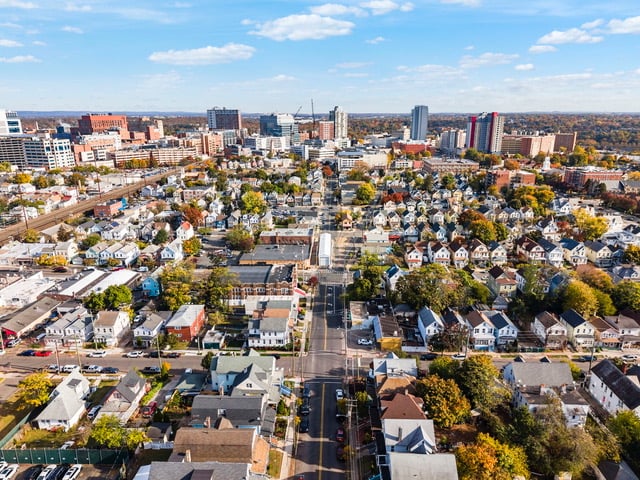
Walk down Elizabeth Avenue on a Tuesday afternoon this September and you'll find the same thing Peterstown has found on Tuesdays for more than a century: folding tables at Union Square Plaza, crates of Jersey Fresh produce, and the Alstede Farms stand doing the same business it's done all season. The market runs through November, which means it's still going right now, and it will keep going through most of the fall before it quietly disappears until next summer, the way it always has.
That's the detail most guides to this neighborhood skip past on their way to whatever restaurant just opened. But the market isn't a footnote here. It's the thing everything else in Peterstown gets built around.
The Market Predates Almost Everything Around It
The Union Square Market has operated as a food institution in this section of Elizabeth since 1917. That's not a marketing anniversary. It's a date that shows up in the neighborhood's own historical record, tied to the same stretch of Elizabeth Avenue that today runs from Bridge Street to Fourth Street through what's now called the Market at Elizabeth Avenue, a shopping district old enough to predate most of the buildings that now line it.
What's easy to miss is that the market wasn't the first food institution to take root here. It was actually a relative latecomer.
The Oven Came First
Thirteen years before the Union Square Market opened, in 1904, a brick oven went into a building in Peterstown that is still baking pizza today. Santillo's Brick Oven Pizza operates out of the oldest and largest brick oven in New Jersey, a 160 square foot structure that's been passed down through three generations of the same family, each one taught the dough by the one before. It has won recognition as one of the best pizzerias in the state and the country, not for reinventing anything, but for not changing the method.
A few blocks over, John's Caffe Pizza and Caterers has been doing the same kind of work since 1968, more than half a century of a father and son team, Gerry and Giovanni, running the ovens on 2nd Avenue. Between the two of them, Santillo's and John's Caffe have been feeding this neighborhood for a combined 180 years, which means the pizza tradition here isn't an amenity that happened to survive. It's older than the farmers market that's supposed to represent the neighborhood's old-world roots, and it's older than nearly every business currently open on the block.
This matters for anyone trying to understand what actually anchors Peterstown, because it flips the assumption most outside guides make. The farmers market gets treated as the historic constant and the restaurants as the rotating cast. Here it runs the other way. The ovens were burning before the market tables went up, and they're still burning now.
The Festival That Runs on a Parish Calendar, Not a Retail One
If the market and the pizzerias are the neighborhood's daily and weekly rhythm, the Peterstown Cultural Festival is its yearly one, and it doesn't follow a retail calendar either.
This year's festival, the 19th annual, ran Thursday through Sunday, July 23 through 26, at 800 Fourth Avenue at High Street. It's presented by the Frank O. Mazza Civic Association, an organization founded by Frank O. Mazza, whose family traces back to Italian immigrants from Vallata, in the Avellino province of Italy, and now chaired by his son, Vito A. Mazza.
The festival's timing isn't arbitrary. It's tied to the religious calendar of the Vallatesi community, the network of Peterstown families and their descendants who trace their roots to Vallata. Several weeks before the street festival, Elizabeth's Saint Anthony Catholic Church holds a Mass honoring Saint Anthony and Saint Vito, a Christian martyr from Sicily who died in the 4th century. The street celebration that follows, with its zeppoles and sausage and peppers and carnival rides, sits on top of a much older religious observance that has nothing to do with tourism or foot traffic.
That's worth sitting with for a second. The biggest annual food event in this neighborhood is scheduled around a parish feast day, not a chamber of commerce calendar. It happens because a specific community has kept a specific tradition alive since before most of the current storefronts existed, back when Peterstown was still transitioning from the German immigrant neighborhood it was in the late 1800s into the Italian-American community it became by the 1920s. The neighborhood's identity has already turned over once. The institutions that anchor daily life outlasted that turnover, and they're built to outlast whatever comes next too.
New Spots Don't Reset the Calendar, They Join It
None of this means Peterstown is frozen. La Kantina, a Mexican restaurant and lounge, opened at 270 Morris Avenue in 2025, adding empanadas, tostadas, ceviche, and birria-style short ribs to a neighborhood dining scene that already includes places like Torna a Sorrento and Dolce Lounge on Broad Street. The area's food scene keeps adding names. What it doesn't do is let a new opening reset what the neighborhood actually runs on.
That's the real pattern here, and it's the one worth understanding if you're trying to get a real read on this part of Elizabeth instead of the version that shows up in a generic city guide. A new restaurant opening is news for a season. A market that's operated continuously since 1917, an oven that's been lit since 1904, and a festival tied to a religious calendar older than the street festival itself are the things that actually structure a Tuesday, a July weekend, or a Sunday dinner here. The newcomers slot into that rhythm. They don't replace it.
If you already live in Peterstown, none of this is a surprise, it's just rarely written down in one place. If you're getting to know the neighborhood from the outside, it's the difference between a list of restaurants and an understanding of why certain ones have survived four generations of ownership while the names around them changed.
Peter Tverdov and the team behind Turnkey Tverdov work in this part of Central New Jersey because we live inside these same rhythms, the market Tuesdays, the parish calendars, the ovens that don't change hands often. If you own property in Elizabeth or you're weighing what a neighborhood like Peterstown actually offers beyond the listing photos, join the Turnkey Waitlist and we'll bring that same street-level read to your conversation.